App Store Launch Planning: What Businesses Often Miss
A buyer-focused guide to an app store launch plan: planning a coherent first release, managing risk, and learning how to coordinate product readiness, store assets, privacy information, review lead time, support, and release ownership.
9 min read

App Store Launch Planning: What Businesses Often Miss addresses a business decision about how to coordinate product readiness, store assets, privacy information, review lead time, support, and release ownership. The strongest first release proves one complete loop rather than displaying many disconnected features. For an app store launch plan, leaders should define the customer or employee outcome, the supporting operational workflow, the information that must remain trustworthy, and the evidence that will justify further investment.
A mobile product earns its place when it makes a repeated task meaningfully easier in the context where people perform it. The business decision is not simply whether an app sounds modern; it is whether mobile capabilities improve a valuable customer or employee loop.
Start with the business outcome
State the intended improvement in one direct sentence, including the people who should benefit. Avoid goals such as “be more digital” or “use AI” because they do not tell a team what to design or a sponsor what to evaluate. A useful statement names a recurring situation, the person facing it, the current friction, and the observable result the business wants.
For an app store launch plan, that result is to coordinate product readiness, store assets, privacy information, review lead time, support, and release ownership. Add boundaries early: the locations, customer groups, employee roles, products, channels, and systems that are in scope. These limits create a decision-ready first release rather than a smaller copy of an imagined final platform.
Define the complete loop from discovery and sign-in through the core action, confirmation, support, and return visit. Include the staff tools and backend decisions required to keep that loop accurate.
Four areas to define before choosing features
1. Product Ready
Describe what product ready means in this business, who owns it, and what a successful state looks like. Capture the normal path and the most costly exception. This prevents a tidy interface from hiding unresolved policy or process decisions.
2. Store Package
Define the information, action, and handoff required for store package. Name the source of truth and who can correct a mistake. If the step depends on another system, document what should happen when that dependency is unavailable or late.
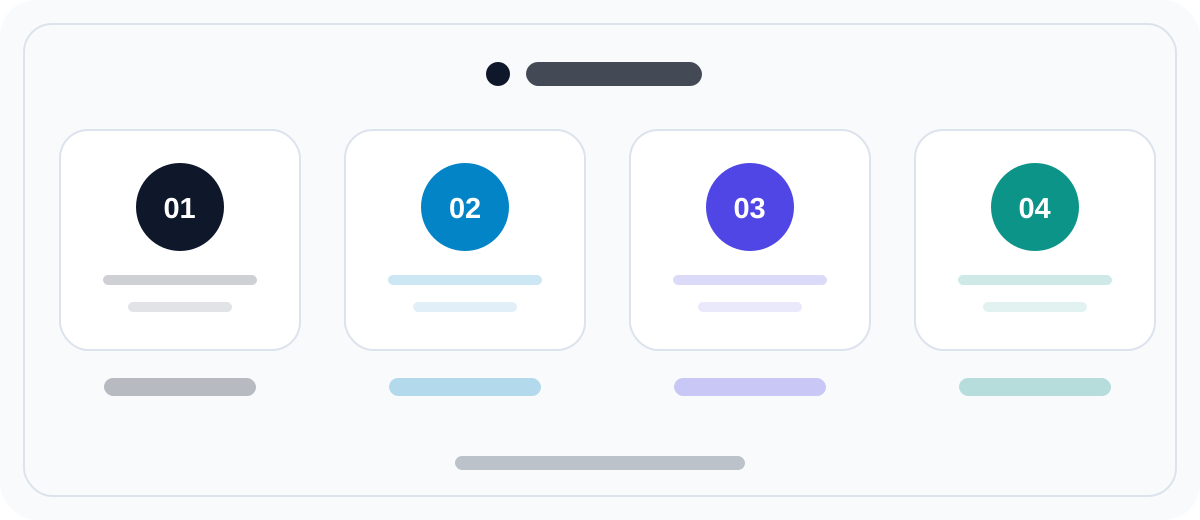
3. Review
Treat review as part of the product rather than an implementation detail. Specify roles, permissions, useful status, and the staff workflow behind the screen. Include support and recovery so users are not trapped when the normal path fails.
4. Support
Connect support to a decision the business can actually make. Decide what evidence is needed, how often it must be current, who reviews it, and which response should follow. A report without an owner or action is decoration.
Scope one complete first release
The initial release is coherent when a representative user can begin, finish the central task, understand the result, and recover from a likely problem. Operational users must be able to see, support, and correct the live workflow. That may require fewer customer-facing features and more attention to administration, data, permissions, and support than an early screen list suggests.
Use three priority groups:
Required for the value loop: capabilities without which the intended outcome cannot happen.
Required to operate safely: permissions, staff controls, audit history, monitoring, and recovery.
Useful after evidence: enhancements that become valuable only after the core loop works in practice.
A bounded release does not require the business to forget future needs. It means making future options visible while refusing to make every option a dependency of the first release.
Decide what to measure
Measure completion, successful return behavior, failure recovery, and support demand. Downloads and screen views can add context, but they do not prove that the mobile product solved the intended job.
Establish today's performance and failure pattern before introducing the new workflow. After launch, review measures as a set rather than optimizing one number in isolation. Faster completion is not an improvement if error recovery, staff rework, or customer confusion rises. Likewise, lower support volume can be misleading if people simply abandon the journey.
Give every useful metric a shared meaning, trusted source, named owner, review rhythm, and connected decision. This small governance step prevents teams from debating dashboards instead of improving the underlying service.
Manage the most likely risks
Decision area | Risk to make visible | Practical safeguard |
|---|---|---|
Product Ready | Channel mismatch | Confirm the decision rule with representative users before expanding scope. |
Store Package | Feature overload | Name the source, owner, and correction path for the information this area needs. |
Review | Weak operations | Test one common failure or exception with the staff responsible for recovery. |
Support | Launch friction | Define the launch measure, operating owner, and response before release. |
A risk register exists to improve decisions, not to imagine every possible failure. It is to expose assumptions that could change cost, timing, trust, or operating responsibility. Give each material risk an owner, an early test, and a response if the assumption proves false.
Build a roadmap around evidence
1. Validate the loop
Interview the people who experience and operate the current process. Review actual artifacts and cases rather than relying only on a workshop description.
2. Prototype the flow
Prototype the critical journey and resolve policy, content, data, and permission questions while changes are still inexpensive.
3. Build the core
Build one end-to-end slice together with the backend and staff controls required for real operation. Test with representative users and realistic data.
4. Learn after launch
After release, compare actual behavior with the starting point and make the next scope decision from evidence.
For a related example of planning a connected product rather than an isolated screen, see this Anemo business guide.
Plan adoption and operating ownership
For an app store launch plan, launch readiness includes more than deployment. Decide who prepares source data, communicates the change, trains the people responsible for product ready, handles questions, corrects records, and reviews support after release. Give staff a safe way to practice the real workflow and its common exceptions before customers or colleagues depend on it.
Name the live-service owner and the product owner separately when the responsibilities differ. The live-service owner protects continuity and response; the product owner uses evidence to choose improvements. This prevents the new system from becoming technically available but operationally unowned.
Turn the scope into a journey storyboard
Create six to ten frames showing how an app store launch plan should work from the user's first signal to a confirmed outcome. Each frame should name the actor, intent, visible information, action, system response, and staff consequence. Include product ready early and make support visible at the point where the business learns whether the journey succeeded.
Add two alternate frames: one for missing or invalid information and one for a dependency that does not respond. These are not edge decoration. They show whether the first release can be operated without staff inventing a private recovery process.
Review the storyboard with people from the customer-facing, operational, and technical sides of the business. Ask each person to mark assumptions rather than silently resolving them. The marked version becomes a better input to design and estimation than a long feature inventory because it preserves why each capability exists.
Finally, remove any frame that does not help the business coordinate product readiness, store assets, privacy information, review lead time, support, and release ownership. Put desirable but unproven ideas into a later-evidence list. The remaining storyboard defines a coherent slice that product design, backend work, testing, and launch planning can share.
Understand cost and timeline drivers
The name of the initiative is not enough information for a responsible estimate. The main drivers are the number of roles and complete workflows, data quality, integrations, migration, permissions, offline or real-time behavior, quality requirements, operating tools, and launch constraints. A short list of screens can still hide substantial rules and backend work.
Compare partners using explicit scope assumptions, dependencies, and exclusions. A lower number based on a happy-path demo is not directly comparable with a proposal that includes staff operations, exception handling, testing, deployment, and support. The useful budget connects money to scope evidence and clear decision points.
Questions to ask a development partner
Which business assumptions should be tested before committing to the full scope?
How will customer-facing work connect to staff operations and supporting systems?
Which risks will you test early, and what evidence will we review?
How will permissions, data correction, failure recovery, and support be handled?
What will our team own at launch, and what documentation and access will we receive?
How will post-launch measurement influence the next roadmap decision?
Frequently asked questions
Should we buy software before considering a custom product?
Usually, compare configurable products first when the workflow is common and differentiation is limited. Custom development becomes more relevant when operating rules, integrations, experience, data control, or future ownership create meaningful business value. A hybrid approach can also be sensible when a standard platform covers commodity capabilities and custom software connects the differentiating workflow.
How detailed should requirements be before speaking with a partner?
You do not need every screen specified. Bring the business outcome, current workflow, known users, systems, constraints, examples, and unresolved questions. A capable discovery process should turn that context into clearer journeys, boundaries, risks, and a roadmap.
What makes a first release credible?
It should complete one valuable journey with realistic data, include the operations needed to support it, handle important failure paths, and produce evidence the business can use. A clickable demo may test understanding, but it is not automatically an operable first release.
Anemo plans and builds connected mobile, web, backend, and operational products around the business decision they need to improve.
