Custom vs Off-the-Shelf Customer Portals: How to Decide
A buyer-focused guide to custom versus configurable customer portals: comparing approaches and partners, managing risk, and learning how to compare workflow fit, integration depth, differentiation, launch effort, and long-term control.
8 min read
Custom vs Off-the-Shelf Customer Portals: How to Decide addresses a business decision about how to compare workflow fit, integration depth, differentiation, launch effort, and long-term control. A clear scope begins with the outcome the business needs to control. For custom versus configurable customer portals, leaders should define the customer or employee outcome, the supporting operational workflow, the information that must remain trustworthy, and the evidence that will justify further investment.
Customer-facing software should remove uncertainty, not merely move a service process online. The useful product shows customers what they can do, what happens next, and how to recover when the normal path does not fit.
Define the decision before comparing options
Clarify whether the decision concerns build, buy, hybrid composition, or selection of the team that will deliver it. Then state the outcome, protected constraints, unresolved assumptions, and evidence required before the next commitment. Without that frame, proposals can appear comparable while solving different problems.
For custom versus configurable customer portals, the aim is to compare workflow fit, integration depth, differentiation, launch effort, and long-term control. Ask every option to address the same representative journey, operating workflow, integration boundaries, quality expectations, and ownership after launch.
Follow the customer request into the staff workflow. A polished portal will still disappoint if employees must retype the request, search for context, or explain statuses that the system cannot represent.
Compare the same four capabilities
1. Workflow Fit
Ask the vendor or internal team to explain its approach to workflow fit using your actual context. Strong answers expose assumptions and tradeoffs. Weak answers repeat generic capability claims or jump to a technology before the problem is understood.
2. Integration
For integration, request a concrete deliverable, review point, or working example. Clarify what your team must provide, what is included, and what would cause the scope or commercial model to change.
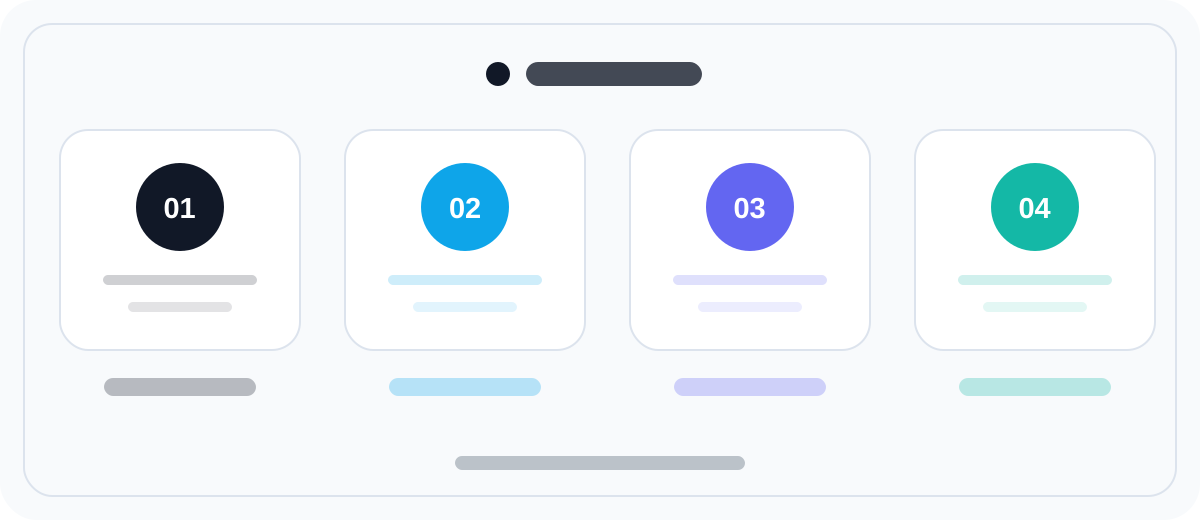
3. Launch Effort
Evaluate how launch effort connects to the live operating model. Ask about permissions, data correction, exception handling, monitoring, support, and handover. Customer-facing polish without these foundations creates hidden ownership for your team.
4. Control
Use control to test long-term fit. Understand access to source code and environments, documentation, data portability, release responsibility, maintenance, and the path for future teams to change the product.
Normalize proposals before comparing price
Create a comparison sheet with one row for each business-critical journey and one column for scope, assumptions, dependencies, evidence, exclusions, and ownership. Ask bidders to confirm or correct it. This makes differences visible without forcing every partner into an identical delivery method.
Area | What to compare | Warning sign |
|---|---|---|
Outcome | The user and business result the work is meant to improve | Success is described only as shipping features |
Scope | Complete journeys, roles, operations, and failure paths | A screen count hides backend or staff work |
Evidence | Prototypes, working slices, tests, and readiness reviews | Progress is reported only through hours or tickets |
Commercials | Assumptions, exclusions, change model, and payment points | A low total depends on unstated happy-path assumptions |
Ownership | Access, documentation, data, deployment, and support | Handover is deferred until the end |
The cheapest proposal may be the best choice when it covers the same outcome and risk. It is not automatically cheaper when it omits discovery, operations, integration, quality, deployment, or support that the business will later need to fund.
Ask for evidence of the delivery approach
A portfolio can show visual quality or domain exposure, but the selection should also examine how the team works. Ask to see anonymized examples of a journey map, scope boundary, architecture decision, risk log, quality plan, or release-readiness review. The goal is not to collect documents; it is to understand whether decisions become visible and testable.
Discuss one difficult scenario from your business. Observe whether the team asks about users, rules, data, exceptions, operations, and measurement before suggesting a solution. This conversation is often more revealing than a polished capabilities presentation.
For a connected-product example, review this Anemo business guide and use the same customer-plus-operations lens when testing proposals.
Make commercial and governance responsibilities explicit
Name the product decision-maker, domain experts, technical owner, acceptance authority, and live-service owner on both sides. Define the meeting and evidence cadence, how risks are escalated, how changes are estimated, and who can approve a tradeoff.
Do not postpone launch ownership. Store accounts, cloud environments, analytics, support access, incident response, dependency updates, and roadmap review all need a named home. A partner may operate some of them, but the business should retain appropriate visibility and exit options.
Review risks before commitment
Decision area | Risk to expose | Evidence to request |
|---|---|---|
Workflow Fit | Digital dead ends | Request the assumption, an early validation step, and the decision that follows. |
Integration | Identity friction | Confirm inclusions, dependencies, exclusions, and the commercial change rule. |
Launch Effort | Hidden staff work | Review a failure scenario, quality evidence, owner, and proposed response. |
Control | Poor recovery | Verify access, documentation, handover, support, and a workable exit path. |
A credible proposal does not claim to remove uncertainty. It shows how uncertainty will be reduced and how the roadmap can change without losing control of the outcome.
Run one reference scenario before the final choice
Give every shortlisted option the same realistic scenario involving workflow fit, a failure or exception around integration, and a business decision tied to control. Ask each team to talk through the user experience, staff response, data movement, evidence, and tradeoffs. The exercise does not need speculative design work. Its purpose is to reveal how the team structures ambiguity, notices operating consequences, and communicates a decision.
Use a weighted scorecard without hiding judgment
Build a short scorecard for custom versus configurable customer portals using Workflow Fit, Integration, Launch Effort, and Control. Give each criterion a plain-language definition and a weight tied to the business outcome. Score evidence, not presentation quality: a clear assumption and validation plan may be stronger than an unsupported promise.
Add a confidence column. A high score based on limited evidence should remain visibly different from a high score supported by working examples, references, or a credible delivery artifact. Record the reason for each score so the final decision can be explained and revisited.
Do not let the total make the choice automatically. Review deal-breakers, concentration risk, team chemistry, commercial constraints, and the cost of changing direction. The scorecard organizes judgment; it does not replace accountable judgment.
Before approval, ask whether the selected option gives the business a believable route to compare workflow fit, integration depth, differentiation, launch effort, and long-term control. If the answer depends on a major assumption, make its early test a condition of the next commitment.
Questions for the final selection conversation
What did you intentionally leave out of the first release, and why?
Which assumption could change the plan most, and how will you test it?
How will customer-facing work connect to staff operations and source systems?
What will we review at each major decision point?
How do you handle quality, security, accessibility, and failure recovery in the delivery process?
Which accounts, code, data, documentation, and environments will our company control?
What happens during launch, support, maintenance, and a future handover?
Frequently asked questions
Should we ask every partner for a fixed price?
Ask for commercial clarity, but match the model to uncertainty. A fixed price is easier to compare when scope and assumptions are stable. When important discovery remains, staged commitments with explicit outputs and decision points can make risk more visible. In either case, understand exclusions and change rules.
How many companies should we compare?
Enough to understand meaningful differences without overwhelming the evaluation. A small shortlist assessed against the same outcome, journey, and decision criteria is usually more useful than a large request sent before the business has clarified its needs.
What should be owned by our business after launch?
Ownership should cover appropriate access to code, environments, data, analytics, store or hosting accounts, documentation, decision history, and support procedures. The exact operating arrangement can vary, but it should not depend on informal knowledge held by one person or supplier.
Anemo provides end-to-end product strategy, UX, mobile, web, backend, quality, launch, and maintenance for businesses commissioning connected software.
