Digital Customer Onboarding: Steps, Metrics, and Examples
A practical guide to digital customer onboarding covering customer journey and service operations, risk, measurement, and clear next steps.
6 min read

Digital customer onboarding is the process of taking a new customer from agreement to actively using your service without paper or manual handoffs: identity checks, document collection, account setup, and the first successful use of what they bought. Measure it by time from signup to first value, completion rate per step, and the share who need human help.
Drop-off concentrates at identity verification and document upload in almost every business, which is where design effort belongs rather than on the welcome screen.
Key takeaways
First value is the goal, not account creation: An account with nothing in it is not an onboarded customer.
Ask for the minimum up front: Collect the rest once the customer has seen something work.
Silence causes abandonment: Tell people what happens next after every submission.
Instrument every step: Without per-step completion rates you are guessing where people leave.
Define what "onboarded" actually means
Most onboarding measurement stops at account creation, which is the least meaningful moment in the process. A customer who has registered and done nothing is not onboarded; they are a record.
Define the first action that constitutes real value for your service — the first order placed, the first document uploaded, the first appointment booked, the first team member invited — and measure to that point. It changes what you optimise, usually away from the signup form and toward what happens immediately after it.
Design the four stages deliberately
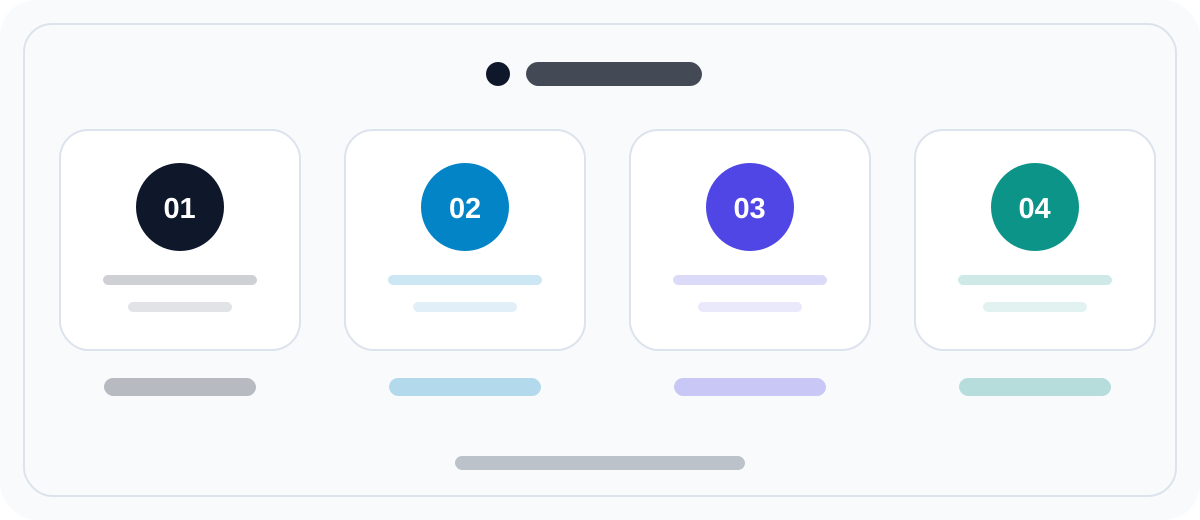
Welcome sets expectation: what will be needed, how long it takes, and what the customer gets at the end. Stating the number of steps up front measurably improves completion.
Verify is identity and eligibility. This is the heaviest stage and the one most constrained by regulation, so design it as the hard part rather than hiding it.
Configure is the setup that makes the service useful — preferences, users, integrations, data. Almost all of it can be deferred.
First value is the moment the customer gets what they came for. Everything before it is cost, for them and for you.
Reduce what you ask for before the first value
Every required field before first value is a reason to abandon. The instinct is to collect everything while the customer is engaged; the effect is that fewer customers reach the point where the data would matter.
Split collection into what you legally need now and what you can request later, in context, when the customer understands why. A field asked at the right moment has a far higher completion rate than the same field asked in a registration form.
Where you already hold information — from a sales conversation, a quote, a CRM record — pre-fill it. Asking a customer for details they have already provided is the most avoidable friction in onboarding and one of the most common.
Handle verification as a designed experience
Identity verification is where onboarding stalls. It involves an external service, variable processing time, and a real possibility of failure through no fault of the customer.
Design for that: tell people what document to prepare before asking, explain what is happening while they wait, give a realistic time estimate, and provide a clear route to a person when automated verification fails. A failed check with no explanation and no next step is where customers stop and do not return.
Where regulation permits, allow provisional access while verification completes. Letting someone explore while their check runs converts substantially better than a blocking wait.
Let people pause and return
Onboarding is frequently interrupted — a missing document, a meeting, a dead battery. If progress is lost, most people do not start again.
Save state at every step, make returning trivial through a link rather than a password reset, and tell people what remains. Where you can, tell them what is missing rather than only that something is.
Never leave the customer in silence
After every submission, say what happened, what happens next, and when. Silence is the single largest cause of abandonment in processes that involve waiting, because the customer cannot distinguish waiting from failure.
This applies to your team as well. Give staff a queue showing who is stuck and where, so a customer waiting on a manual check is visible rather than discovered when they complain. Every customer-facing step creates internal work, and onboarding is where that is felt fastest.
Measure per step, then fix the worst one
Instrument completion at every step and time between steps. One number for the whole funnel tells you there is a problem; per-step data tells you where.
Expect the worst step to be verification or document upload. Fix that one, measure again, and repeat. Onboarding improves in single steps rather than in redesigns, and the sequence of small fixes usually outperforms rebuilding the flow.
Frequently asked questions
What is digital customer onboarding?
The process of taking a new customer from agreement to actively using your service without paper or manual handoffs — identity checks, document collection, account setup, and the first successful use of what they bought.
How do you measure onboarding success?
Time from signup to first value, completion rate per step, and the proportion who need human help. Drop-off concentrates at identity verification and document upload in almost every business.
How long should digital onboarding take?
As few steps as your obligations allow. Where regulation permits, minutes rather than days is achievable; where verification is required, tell the customer what is happening and how long it will take rather than leaving them waiting.
Related guides
Related reading:
Customer Portal Development: Workflows, Integrations, and Adoption
Appointment Booking App Development: Workflows Your MVP Needs
If the work prompted by Digital Customer Onboarding: Steps, Metrics, and Examples leads to a funded initiative that needs product strategy, design, engineering, or integration support, Discuss Your Customer Platform.
