How to Build a Digital Operating Model for Your Business
A buyer-focused guide to a digital operating model: understanding the opportunity, managing risk, and learning how to connect roles, workflows, systems, data, and management decisions in one practical model.
9 min read

How to Build a Digital Operating Model for Your Business addresses a business decision about how to connect roles, workflows, systems, data, and management decisions in one practical model. The useful starting point is a business decision, not a feature list. For a digital operating model, leaders should define the customer or employee outcome, the supporting operational workflow, the information that must remain trustworthy, and the evidence that will justify further investment.
A useful digital operating model connects how work enters the business, who decides what happens next, where trustworthy information lives, and how leaders learn from outcomes. Technology creates leverage only when those responsibilities become clearer.
Key takeaways
Define the decision first: How should business owners, operations leaders, and transformation teams turning fragmented work into a measurable operating model evaluate the opportunity or problem around a digital operating model so they can connect roles, workflows, systems, data, and management decisions in one practical model?
Plan the connected system: Treat target outcome, workflow and ownership, data and systems, and measurement and adoption as one operating model.
Expose risk early: Test assumptions around Unclear priorities, Process drift, and Adoption gap before a large commitment.
Measure the change: Track cycle time, error and rework, adoption, and service outcome with a named owner and response.
Look for the business signal behind the technology
The case for a digital operating model should begin with repeated evidence from the business. Listen for customers asking for the same status, employees rebuilding the same report, managers waiting for information, or teams inventing side processes to keep work moving. A single frustrating incident may need a service fix; a stable pattern across people, time, or locations may justify product investment.
Treat human involvement as a design question rather than an automatic defect. Some steps carry judgment, trust, or flexibility that software should support rather than erase. The assessment should separate necessary human decisions from avoidable searching, retyping, coordination, and uncertainty.
Trace one valuable process across customer contact, employee action, systems, decisions, and management review. Mark recurring delays, duplicate records, policy choices, and exception routes before deciding which layer should change.
Use four lenses to understand the opportunity
Customer Signal
Ask how customer signal affects the outcome today. Gather recent examples, including one normal case and one exception. Note what people need, which decision they are trying to make, where they hesitate, and which workaround they use when the formal process does not help.
Team Decision
For team decision, identify ownership and handoffs. A visible delay may begin earlier than the screen or team where it appears. Record who creates the information, who checks it, who acts on it, and who must explain a mistake.
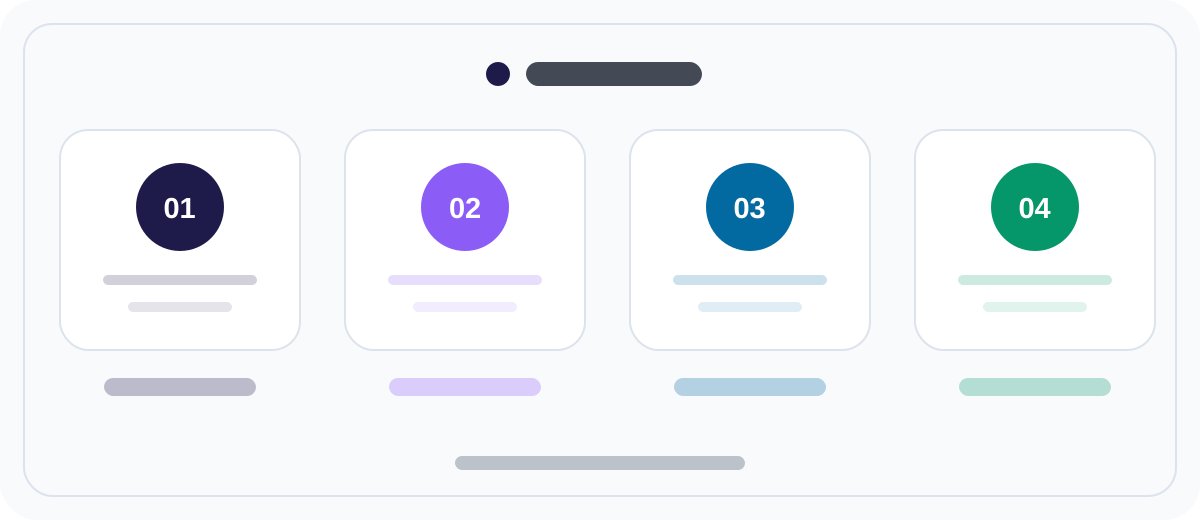
Shared System
Examine the quality and availability of shared system. If people disagree about definitions, rely on several versions, or cannot correct a record, a new dashboard may amplify confusion. Agree on the source of truth and correction process before using the data to automate or evaluate work.
Outcome Review
Connect outcome review to a management decision. Define what a leader or team would do differently if the information were timely and trustworthy. That answer helps distinguish an actionable product from a passive reporting layer.
Assess the current state without buying software first
The initial evidence can be directional rather than statistically perfect. Their purpose is to make the pattern specific enough to discuss and to create a baseline for later comparison. Avoid collecting personal or sensitive data merely because it is available; the assessment should be proportionate to the decision.
Decide what useful measurement looks like
Measure adoption together with cycle time, rework, exception volume, customer outcome, and management response. A rising login count does not prove transformation if the old channels and reconciliation work remain necessary.
For a digital operating model, document each proposed measure with five fields: definition, source, owner, review frequency, and intended response. Include a balancing measure so local optimization does not move the problem elsewhere. For example, faster completion should be considered alongside error, rework, customer effort, or outcome quality.
When software is likely to help
Software becomes a stronger option when the work is repeated, the rules are sufficiently understandable, several people need the same trustworthy state, delays or errors matter, and a clear owner can operate the result. Mobile, web, automation, integration, and analytics may play different roles; there is no requirement to turn every improvement into a new app.
Treat vague outcomes, unstable workflows, unresolved policy, unreliable data, and missing ownership as discovery work rather than build scope. In those conditions, development can make uncertainty faster without making the business better.
For a related view of how customer-facing screens connect to operations and data, see this Anemo planning guide.
Start with a bounded improvement
Begin with one material workflow and a representative group that can test the change. Define the before state, the change, the responsible owner, and a review date. Prototype the workflow before committing to a large platform, and include the staff view and exception path in the test.
Build a measurement map before a dashboard
A dashboard is a presentation layer, so begin with the chain of meaning underneath it. For a digital operating model, write the business question at the top of a page. Under it, list the decision owner, the action available, and the evidence required. Only then identify measures related to customer signal, team decision, shared system, and outcome review.
The measurement map is useful even if the next step is not software. It clarifies whether the business can connect roles, workflows, systems, data, and management decisions in one practical model with existing information or whether a product must improve capture, quality, connection, and response.
Risks to make visible
Lens | Common risk | Early response |
|---|---|---|
Customer Signal | Unclear priorities | Review recent cases with the people who experience this part of the journey. |
Team Decision | Process drift | Trace ownership and handoffs, including the workaround used when the normal path fails. |
Shared System | Adoption gap | Check definitions, source data, access, and the route for correcting a mistake. |
Outcome Review | Weak evidence | Name the decision, responsible owner, balancing measure, and review date. |
A 30-day validation plan: Digital operating model
Days 1–5 — establish the current evidence. Before choosing an approach for How to Build a Digital Operating Model for Your Business, follow one real example from request to outcome. Record who starts the work, where a decision waits, which data is re-entered, and what proves completion. Put a number against the current state of target outcome and collect at least two examples showing how Unclear priorities appears today. The team can then evaluate change against a shared baseline instead of a collection of opinions.
Days 6–15 — test a narrow scenario. Use How to Build a Digital Operating Model for Your Business to frame one user group, one critical path, and one meaningful exception. Define the responsible role, required data, permission boundary, and fallback for workflow and ownership. If the test exposes Process drift or Adoption gap, do not add scope. Separate the cause, make the smallest useful correction, and run the same scenario again. The pilot should reduce the most expensive uncertainty, not demonstrate the largest number of features.
Days 16–30 — decide from outcomes and ownership. For How to Build a Digital Operating Model for Your Business, compare cycle time, error and rework, adoption, and service outcome with the baseline. Review the numbers beside user feedback, error evidence, and operational observation. Do not expand while ownership of data and systems or measurement and adoption remains ambiguous. Close the month with a short continue, revise, or stop decision that records the evidence, accountable owner, next review date, and the assumptions that still need to be tested.
A practical worksheet: Digital operating model
For How to Build a Digital Operating Model for Your Business, complete these five rows before making an investment or solution decision. The aim is not to write a long specification; it is to make the outcome, boundaries, and evidence behind the decision visible.
Decision area | What to record |
|---|---|
Target outcome for digital operating model | The user or business result that should change, its current baseline, and the decision owner |
target outcome | The normal journey, most important exception, responsible role, and evidence of completion |
workflow and ownership | Required data, authoritative system, freshness expectation, and correction route |
Priority risk | An early test and fallback decision for Unclear priorities, Process drift, and Adoption gap |
Measurement | Definition, source, review cadence, and response for cycle time, error and rework, adoption, and service outcome |
If the How to Build a Digital Operating Model for Your Business worksheet exposes conflicting assumptions, resolve them before expanding scope. Bring product, operational, and technical owners together to define the boundary for data and systems and the responsibility for measurement and adoption.
Frequently asked questions
What is a digital operating model?
The description of how your business runs once technology is part of it: which processes exist, who owns them, which systems hold which data, how decisions are made, and how change is delivered. It is an organisational design, not an architecture diagram.
How is an operating model different from a strategy?
Strategy says what you intend to achieve. The operating model says how the organisation is arranged to deliver it — roles, processes, systems and decision rights. Most transformation failures are operating-model failures, not strategy failures.
Who should own the digital operating model?
Someone with authority over both process and budget, usually at executive level. Assigning it to IT alone reliably produces a systems plan that the business does not adopt.
Related guides
Alongside How to Build a Digital Operating Model for Your Business, continue with Digital Transformation Roadmap: A 7-Step Business Guide.
Alongside How to Build a Digital Operating Model for Your Business, continue with Paperless Workflow: How to Digitize Paper-Based Processes.
If the work prompted by How to Build a Digital Operating Model for Your Business leads to a funded initiative that needs product strategy, design, engineering, or integration support, Discuss Your Digital Roadmap.
