Why Digitizing Your Business Matters
A buyer-focused guide to business digitization: understanding the opportunity, managing risk, and learning how to turn recurring work and information into a more visible, measurable operating system.
8 min read

Why Digitizing Your Business Matters addresses a business decision about how to turn recurring work and information into a more visible, measurable operating system. The useful starting point is a business decision, not a feature list. For business digitization, leaders should define the customer or employee outcome, the supporting operational workflow, the information that must remain trustworthy, and the evidence that will justify further investment.
Digitization creates value when information becomes easier to capture, work becomes easier to coordinate, and decisions become easier to verify. Replacing paper with screens is not enough if teams still reconcile the same information by hand.
Look for the business signal behind the technology
The case for business digitization should begin with repeated evidence from the business. Listen for customers asking for the same status, employees rebuilding the same report, managers waiting for information, or teams inventing side processes to keep work moving. A single frustrating incident may need a service fix; a stable pattern across people, time, or locations may justify product investment.
Manual work is not automatically wasteful. Some steps carry judgment, trust, or flexibility that software should support rather than erase. The assessment should separate necessary human decisions from avoidable searching, retyping, coordination, and uncertainty.
Map how a customer request or internal task moves from first signal to final outcome. The map should name the people involved, the handoffs, the source of truth, and the exceptions that consume management attention.
Use four lenses to understand the opportunity
Customer Journey
Ask how customer journey affects the outcome today. Gather recent examples, including one normal case and one exception. Note what people need, which decision they are trying to make, where they hesitate, and which workaround they use when the formal process does not help.
Team Workflow
For team workflow, identify ownership and handoffs. A visible delay may begin earlier than the screen or team where it appears. Record who creates the information, who checks it, who acts on it, and who must explain a mistake.
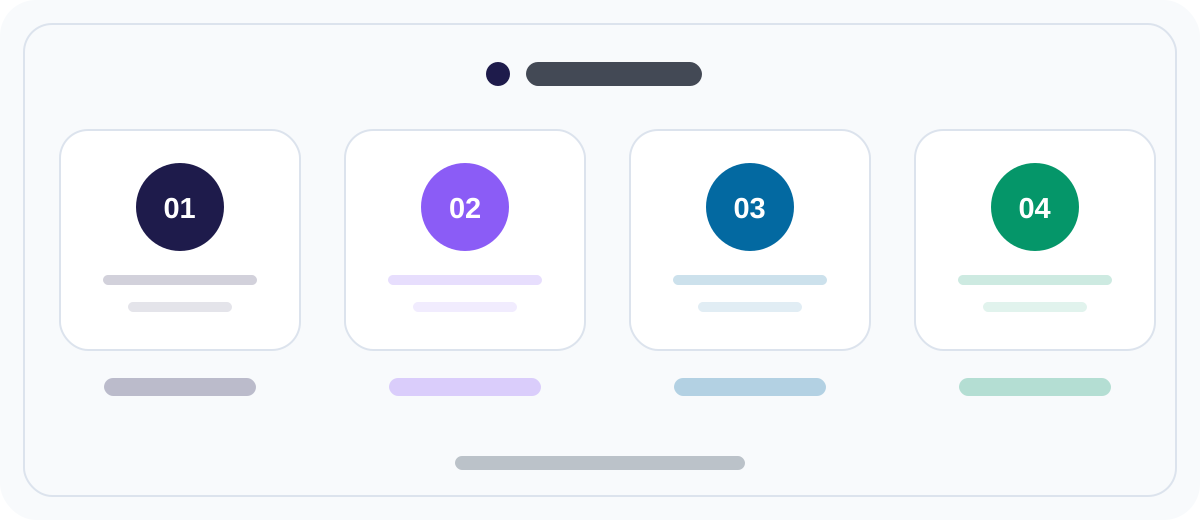
Shared Data
Examine the quality and availability of shared data. If people disagree about definitions, rely on several versions, or cannot correct a record, a new dashboard may amplify confusion. Agree on the source of truth and correction process before using the data to automate or evaluate work.
Management View
Connect management view to a management decision. Define what a leader or team would do differently if the information were timely and trustworthy. That answer helps distinguish an actionable product from a passive reporting layer.
Assess the current state without buying software first
Choose a representative period or journey and collect lightweight evidence:
Follow ten recent cases from beginning to outcome.
Count handoffs, duplicate entries, status requests, and manual reconciliations.
Mark delays caused by policy, missing information, system limits, or capacity.
Ask customers and employees where they lose confidence or create workarounds.
Identify which decision would improve if the underlying information became clearer.
The numbers do not need to be perfect. Their purpose is to make the pattern specific enough to discuss and to create a baseline for later comparison. Avoid collecting personal or sensitive data merely because it is available; the assessment should be proportionate to the decision.
Decide what useful measurement looks like
Choose a small set of measures tied to an operating decision. A metric deserves space in the product only when someone owns it, understands its definition, and can take a clear action when it changes.
For business digitization, document each proposed measure with five fields: definition, source, owner, review frequency, and intended response. Include a balancing measure so local optimization does not move the problem elsewhere. For example, faster completion should be considered alongside error, rework, customer effort, or outcome quality.
Measurement also helps the business decide not to build. If the evidence shows a rare problem, unclear ownership, or a policy conflict, a process or management change may produce more value than a new platform.
When software is likely to help
Investment is easier to justify when the workflow repeats, important rules are knowable, several roles need consistent information, and ownership is clear. Mobile, web, automation, integration, and analytics may play different roles; there is no requirement to turn every improvement into a new app.
Delay a large build when the outcome, process, policy, source data, or adoption owner remains fundamentally unclear. In those conditions, development can make uncertainty faster without making the business better.
For a related view of how customer-facing screens connect to operations and data, see this Anemo planning guide.
Start with a bounded improvement
Anchor the pilot in a recurring situation, a useful outcome, and people who can provide timely evidence. Define the before state, the change, the responsible owner, and a review date. Prototype the workflow before committing to a large platform, and include the staff view and exception path in the test.
A credible pilot should answer a business question. It might show whether customers complete a task with less assistance, whether employees recover exceptions with less rework, whether management sees reliable status earlier, or whether one shared record removes reconciliation. The next investment should depend on that evidence.
Read the opportunity from the outside in
Start with the moment a customer, employee, or manager notices the problem—not with the system that currently records it. For business digitization, describe what the person is trying to accomplish, what they can observe, and when they must ask someone else for help. Then follow the request inward through customer journey and team workflow until the business can see where uncertainty actually enters.
This outside-in view prevents an internal efficiency project from making the external journey harder. It also reveals when a communication change, clearer policy, or better ownership may solve part of the problem before software is introduced.
Create a one-page opportunity statement with four fields: repeated situation, affected people, current consequence, and desired evidence. Add one counterexample—a case where the current approach works well. The counterexample protects useful flexibility and keeps the team from designing around only its most frustrating cases.
Finish by naming the smallest change that could demonstrate progress toward this outcome: turn recurring work and information into a more visible, measurable operating system. That change becomes a learning boundary, not a promise to automate the whole business.
Risks to make visible
Lens | Common risk | Early response |
|---|---|---|
Customer Journey | Digitizing waste | Review recent cases with the people who experience this part of the journey. |
Team Workflow | Unclear ownership | Trace ownership and handoffs, including the workaround used when the normal path fails. |
Shared Data | Fragmented data | Check definitions, source data, access, and the route for correcting a mistake. |
Management View | Low adoption | Name the decision, responsible owner, balancing measure, and review date. |
These risks do not mean the business should avoid improving the workflow or investing in software. They mean the initiative needs an owner, a boundary, and a way to learn before scale.
A practical decision checklist
Can we name the recurring customer, employee, or management decision?
Do recent cases show material friction rather than an isolated complaint?
Do we understand the normal workflow and important exceptions?
Is the required information available, trustworthy, and appropriate to use?
Does someone own adoption, operation, and response after launch?
Can a bounded pilot produce evidence for the next decision?
Frequently asked questions
Does acting on this opportunity require a large transformation program?
No. A focused workflow can be a better starting point when it has a clear owner and measurable outcome. The architecture should keep future connections possible, but the first investment can remain small enough to test.
Should the business measure customers and employees in the same way?
No. The purpose, context, access, and consequences differ. Customer measures should help improve a journey or relationship. Employee measures require particular care because work varies by role and context, and simplistic activity counts can be unfair. Be transparent about purpose and use human review where measures affect people.
What should we prepare before speaking with a development partner?
Bring the outcome, examples of the current workflow, representative users, existing systems, known constraints, and baseline evidence. You do not need a finished feature specification. A useful partner should help turn the operating context into a testable product boundary.
Anemo helps businesses turn recurring customer and operational problems into connected mobile, web, backend, automation, and analytics products.
