Customer Retention Strategies: When Software Helps
A practical guide to customer retention strategies covering customer journey and service operations, risk, measurement, and clear next steps.
7 min read
Software helps retention when the reason customers leave is friction you can remove or a signal you failed to notice in time. It does not help when they leave because the product does not deliver enough value, the price is wrong, or a competitor is genuinely better. Diagnose which of those you have before funding a retention tool, because the three have almost nothing in common.
This guide covers how to find the actual cause, where software earns its place, what to build first, and how to tell whether it worked.
Key takeaways
Diagnose before you build: Retention problems caused by value, price or competition are not fixed by software.
The first weeks decide the rest: Most churn is set during onboarding, long before the cancellation.
Act on behaviour, not on a score: Usage decline is a more reliable signal than any satisfaction number.
Cancellation reasons are the cheapest research available: Almost nobody reads them systematically.
Find out why customers actually leave
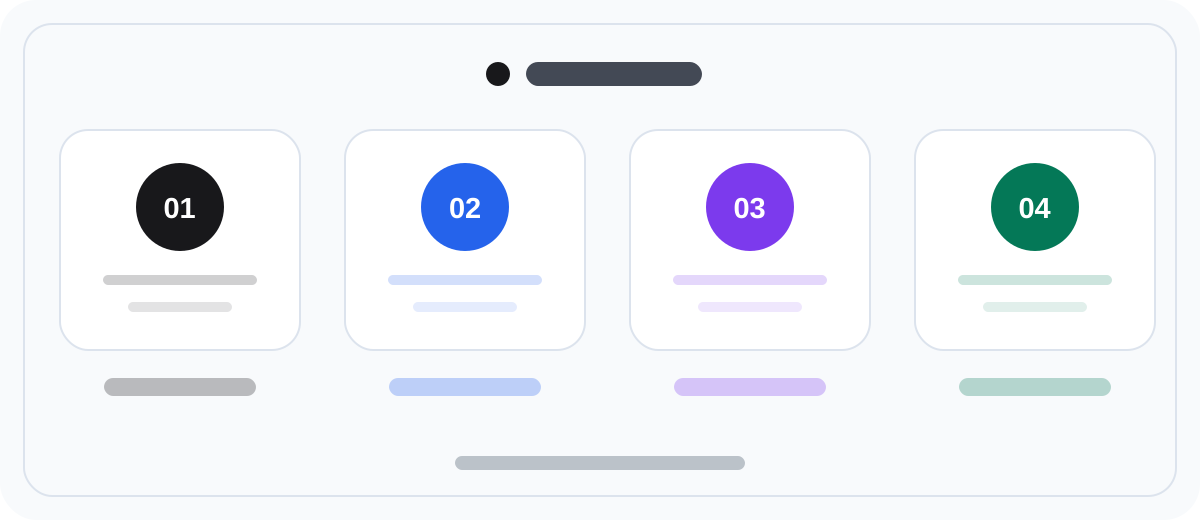
Retention work goes wrong when the cause is assumed. There are four broad causes and they need different responses:
They never got value. They signed up, did not reach the point where the product becomes useful, and drifted. This is an onboarding problem and it is the most common one.
They got value and then hit friction. Something broke, support was slow, a process was painful. This is a service and product problem, and it is the one software helps most with.
The value was real but not worth the price. This is a pricing or packaging problem. A retention campaign will delay it, not solve it.
Someone else is better. This is a product strategy problem, and no amount of lifecycle messaging changes it.
Read your own cancellation reasons, and interview twenty customers who left in the last quarter. It is unglamorous and it is the highest-return research available, because the answer determines whether the next twelve months of work are useful.
Understand where the churn actually happens
Churn is usually decided long before it is recorded. A customer who cancels in month nine frequently stopped using the product in month two.
That is why the highest-leverage retention work is almost always early: getting a new customer to the first moment of real value quickly. Define what that moment is for your product — the first completed order, the first invited colleague, the first report generated — and measure how many customers reach it and how long it takes.
Improving that number moves retention more than any win-back campaign, because it addresses the cohort before it forms an opinion.
Decide where software earns its place
Capability | What it does | Worth building when |
|---|---|---|
Usage and health tracking | Shows which accounts are disengaging | You cannot currently tell who is at risk |
Risk signals and alerts | Routes at-risk accounts to a person | Someone is available to act on the alert |
Lifecycle messaging | Guides customers to the next useful action | Onboarding drop-off is the diagnosed cause |
Self-service resolution | Removes the friction that triggers cancellation | Support contact precedes churn in your data |
Cancellation flow with reasons | Captures why, and offers relevant alternatives | Always — it is cheap and it is your research |
The cancellation flow is the item most often skipped and the one with the best return. It costs little, it saves a portion of the customers who reach it, and it produces the data that tells you what to fix next.
Do not build alerts nobody acts on
A health score dashboard with no attached workflow is a common and expensive mistake. The alert has to reach a named person with the time and authority to do something, and there has to be a defined action.
Decide before building: what triggers an alert, who receives it, what they are expected to do, and what happens if they do nothing. If the honest answer to the third question is "look at it", the dashboard will be ignored within a quarter.
Behavioural signals beat sentiment scores here. Declining logins, an unused core feature, a support ticket that took too long, a failed payment, a champion who left the company — these are concrete and actionable. A satisfaction score is a lagging summary of them.
Fix the friction rather than messaging around it
Lifecycle messaging is easy to build and easy to overdo. If customers churn because a process is painful, more emails about that process will not help.
Sequence the work accordingly: remove the friction first, then use messaging to guide people through what remains. The most effective retention change is frequently a product change — a clearer setup flow, a faster support path, a self-service action that previously required a phone call.
For the earlier half of this problem, see digital customer onboarding.
Handle the data and the discounting carefully
Retention systems profile customers by behaviour and sometimes predict who will leave. Under GDPR and Turkish data protection law, tell people what you collect and why, keep a lawful basis for the processing, and be careful where a prediction leads to materially different treatment of an individual — different pricing, different service levels — as that is where profiling obligations bite.
There is a commercial trap alongside the legal one. Retention discounts offered automatically to anyone who threatens to leave teach customers to threaten to leave. Use them selectively and measure whether the saved revenue exceeds the discount given to customers who would have stayed anyway.
Measure cohorts, not an average
Track retention by cohort — customers who joined in the same period — rather than as a single monthly rate, because an average hides whether your changes are working on new customers.
Alongside it, measure time to first value, the share of customers reaching it, activity decline as a leading indicator, and revenue retention separately from customer retention. Losing many small accounts and losing one large one are very different problems that a single churn percentage reports identically.
Frequently asked questions
What should be defined first?
For Customer Retention Strategies: When Software Helps, start by defining the expected result and owner for customer journey. Then follow one real example through service operations, recording the data used, waiting points, exceptions, and evidence of completion. This creates a more reliable first scope than a screen inventory.
How should success be measured?
For Customer Retention Strategies: When Software Helps, review journey completion, repeat contact, resolution time, and retention together. Give each measure a definition, data source, owner, review cadence, and response when it crosses a threshold. A single speed or usage metric should not hide quality, rework, or abandonment.
Does this work always require new software?
For Customer Retention Strategies: When Software Helps, new software is not automatic. If the underlying problem is policy, ownership, training, or an unnecessary approval, fix the process first. Configure an established tool when it supports the critical workflow and data boundary. Consider custom development only when a differentiating rule, integration, or experience creates clear value.
Related guides
Alongside Customer Retention Strategies: When Software Helps, continue with Customer Portal Development: Workflows, Integrations, and Adoption.
Alongside Customer Retention Strategies: When Software Helps, continue with Digital Customer Onboarding: Steps, Metrics, and Examples.
If the work prompted by Customer Retention Strategies: When Software Helps leads to a funded initiative that needs product strategy, design, engineering, or integration support, Discuss Your Customer Platform.
