How to Digitize a Multi-Location Business Without Losing Local Context
A buyer-focused guide to multi-location business digitization: comparing approaches and partners, managing risk, and learning how to balance shared workflows, local permissions, master data, reporting, and phased rollout.
9 min read

How to Digitize a Multi-Location Business Without Losing Local Context addresses a business decision about how to balance shared workflows, local permissions, master data, reporting, and phased rollout. A clear scope begins with the outcome the business needs to control. For multi-location business digitization, leaders should define the customer or employee outcome, the supporting operational workflow, the information that must remain trustworthy, and the evidence that will justify further investment.
A useful digital operating model connects how work enters the business, who decides what happens next, where trustworthy information lives, and how leaders learn from outcomes. Technology creates leverage only when those responsibilities become clearer.
Key takeaways
Define the decision first: How should business owners, operations leaders, and transformation teams turning fragmented work into a measurable operating model choose the right partner or approach for multi-location business digitization so they can balance shared workflows, local permissions, master data, reporting, and phased rollout?
Plan the connected system: Treat target outcome, workflow and ownership, data and systems, and measurement and adoption as one operating model.
Expose risk early: Test assumptions around Unclear priorities, Process drift, and Adoption gap before a large commitment.
Measure the change: Track cycle time, error and rework, adoption, and service outcome with a named owner and response.
Define the decision before comparing options
Name the actual selection before scoring options—an approach, a product, a partner, or a combination of them. Then state the outcome, protected constraints, unresolved assumptions, and evidence required before the next commitment. Without that frame, proposals can appear comparable while solving different problems.
For multi-location business digitization, the aim is to balance shared workflows, local permissions, master data, reporting, and phased rollout. Ask every option to address the same representative journey, operating workflow, integration boundaries, quality expectations, and ownership after launch.
Trace one valuable process across customer contact, employee action, systems, decisions, and management review. Mark recurring delays, duplicate records, policy choices, and exception routes before deciding which layer should change.
Compare the same four capabilities
1. Shared Standard
Ask the vendor or internal team to explain its approach to shared standard using your actual context. Strong answers expose assumptions and tradeoffs. Weak answers repeat generic capability claims or jump to a technology before the problem is understood.
2. Local Workflow
For local workflow, request a concrete deliverable, review point, or working example. Clarify what your team must provide, what is included, and what would cause the scope or commercial model to change.
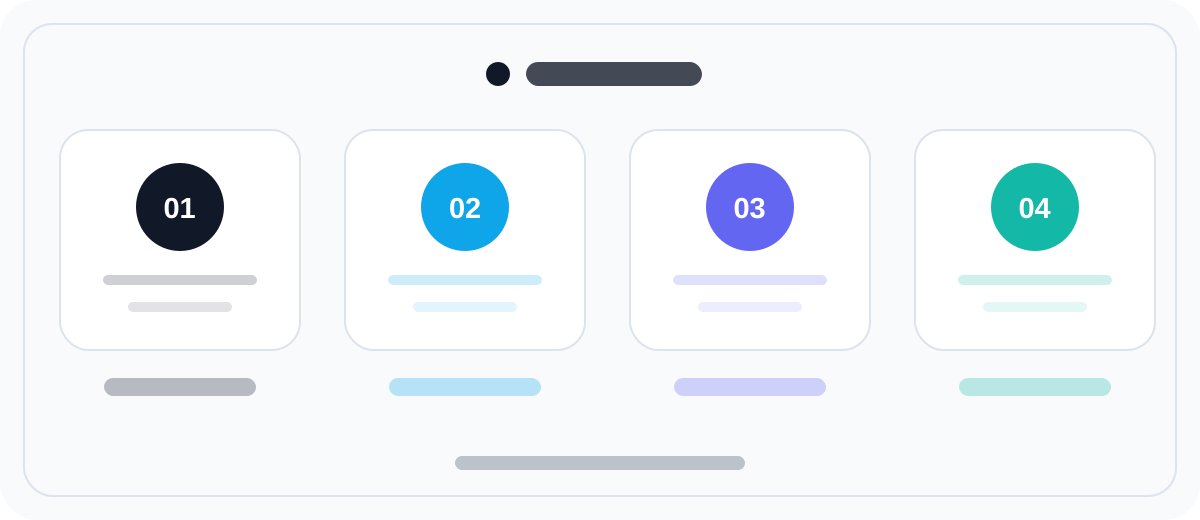
3. Central Data
Evaluate how central data connects to the live operating model. Ask about permissions, data correction, exception handling, monitoring, support, and handover. Customer-facing polish without these foundations creates hidden ownership for your team.
4. Rollout
Use rollout to test long-term fit. Understand access to source code and environments, documentation, data portability, release responsibility, maintenance, and the path for future teams to change the product.
Normalize proposals before comparing price
Area | What to compare | Warning sign |
|---|---|---|
Outcome | The user and business result the work is meant to improve | Success is described only as shipping features |
Scope | Complete journeys, roles, operations, and failure paths | A screen count hides backend or staff work |
Evidence | Prototypes, working slices, tests, and readiness reviews | Progress is reported only through hours or tickets |
Commercials | Assumptions, exclusions, change model, and payment points | A low total depends on unstated happy-path assumptions |
Ownership | Access, documentation, data, deployment, and support | Handover is deferred until the end |
Ask for evidence of the delivery approach
Past work helps establish credibility, but delivery practice and decision quality require their own evidence. Ask to see anonymized examples of a journey map, scope boundary, architecture decision, risk log, quality plan, or release-readiness review. The goal is not to collect documents; it is to understand whether decisions become visible and testable.
For a connected-product example, review this Anemo business guide and use the same customer-plus-operations lens when testing proposals.
Make commercial and governance responsibilities explicit
Make live-operation ownership explicit while the approach and commercials are still being agreed. Store accounts, cloud environments, analytics, support access, incident response, dependency updates, and roadmap review all need a named home. A partner may operate some of them, but the business should retain appropriate visibility and exit options.
Review risks before commitment
Decision area | Risk to expose | Evidence to request |
|---|---|---|
Shared Standard | Unclear priorities | Request the assumption, an early validation step, and the decision that follows. |
Local Workflow | Process drift | Confirm inclusions, dependencies, exclusions, and the commercial change rule. |
Central Data | Adoption gap | Review a failure scenario, quality evidence, owner, and proposed response. |
Rollout | Weak evidence | Verify access, documentation, handover, support, and a workable exit path. |
A trustworthy proposal shows how open questions will be answered over time. It shows how uncertainty will be reduced and how the roadmap can change without losing control of the outcome.
Run one reference scenario before the final choice
Give every shortlisted option the same realistic scenario involving shared standard, a failure or exception around local workflow, and a business decision tied to rollout. Ask each team to talk through the user experience, staff response, data movement, evidence, and tradeoffs. The exercise does not need speculative design work. Its purpose is to reveal how the team structures ambiguity, notices operating consequences, and communicates a decision.
Test ownership with a future handover exercise
Imagine that the team responsible for multi-location business digitization changes one year after launch. Ask each option to explain how a new team would understand shared standard, operate local workflow, diagnose problems around central data, and take responsibility for rollout.
Review the expected source access, environment ownership, data export, deployment process, monitoring, documentation, decision history, dependency list, and support procedures. Do not require paperwork for its own sake; require the information and access a competent team would need to protect continuity.
Then test a change request. Ask how a newly discovered rule or integration constraint would move from business decision to estimate, design, implementation, verification, release, and documentation. The answer exposes the real change model behind the proposal.
This future-handover view helps the business balance shared workflows, local permissions, master data, reporting, and phased rollout without creating avoidable supplier dependency. It also distinguishes a partner willing to build durable ownership from one whose process remains understandable only while the original individuals are present.
A 30-day validation plan: Multi location business digitization
Days 1–5 — establish the current evidence. Before choosing an approach for How to Digitize a Multi-Location Business Without Losing Local Context, follow one real example from request to outcome. Record who starts the work, where a decision waits, which data is re-entered, and what proves completion. Put a number against the current state of target outcome and collect at least two examples showing how Unclear priorities appears today. The team can then evaluate change against a shared baseline instead of a collection of opinions.
Days 6–15 — test a narrow scenario. Use How to Digitize a Multi-Location Business Without Losing Local Context to frame one user group, one critical path, and one meaningful exception. Define the responsible role, required data, permission boundary, and fallback for workflow and ownership. If the test exposes Process drift or Adoption gap, do not add scope. Separate the cause, make the smallest useful correction, and run the same scenario again. The pilot should reduce the most expensive uncertainty, not demonstrate the largest number of features.
Days 16–30 — decide from outcomes and ownership. For How to Digitize a Multi-Location Business Without Losing Local Context, compare cycle time, error and rework, adoption, and service outcome with the baseline. Review the numbers beside user feedback, error evidence, and operational observation. Do not expand while ownership of data and systems or measurement and adoption remains ambiguous. Close the month with a short continue, revise, or stop decision that records the evidence, accountable owner, next review date, and the assumptions that still need to be tested.
A practical worksheet: Multi location business digitization
For How to Digitize a Multi-Location Business Without Losing Local Context, complete these five rows before making an investment or solution decision. The aim is not to write a long specification; it is to make the outcome, boundaries, and evidence behind the decision visible.
Decision area | What to record |
|---|---|
Target outcome for multi location business digitization | The user or business result that should change, its current baseline, and the decision owner |
target outcome | The normal journey, most important exception, responsible role, and evidence of completion |
workflow and ownership | Required data, authoritative system, freshness expectation, and correction route |
Priority risk | An early test and fallback decision for Unclear priorities, Process drift, and Adoption gap |
Measurement | Definition, source, review cadence, and response for cycle time, error and rework, adoption, and service outcome |
If the How to Digitize a Multi-Location Business Without Losing Local Context worksheet exposes conflicting assumptions, resolve them before expanding scope. Bring product, operational, and technical owners together to define the boundary for data and systems and the responsibility for measurement and adoption.
Frequently asked questions
What should be defined first?
For How to Digitize a Multi-Location Business Without Losing Local Context, start by defining the expected result and owner for target outcome. Then follow one real example through workflow and ownership, recording the data used, waiting points, exceptions, and evidence of completion. This creates a more reliable first scope than a screen inventory.
How should success be measured?
For How to Digitize a Multi-Location Business Without Losing Local Context, review cycle time, error and rework, adoption, and service outcome together. Give each measure a definition, data source, owner, review cadence, and response when it crosses a threshold. A single speed or usage metric should not hide quality, rework, or abandonment.
What evidence should be compared before choosing an approach?
For multi location business digitization, compare options against the same representative scenario for scope, assumptions, dependencies, exceptions, security responsibility, delivery evidence, and live-support ownership. A feature or total-price comparison alone can hide cost-changing issues such as Unclear priorities and Process drift.
Related guides
Alongside How to Digitize a Multi-Location Business Without Losing Local Context, continue with Digital Transformation Roadmap: A 7-Step Business Guide.
Alongside How to Digitize a Multi-Location Business Without Losing Local Context, continue with Paperless Workflow: How to Digitize Paper-Based Processes.
If the work prompted by How to Digitize a Multi-Location Business Without Losing Local Context leads to a funded initiative that needs product strategy, design, engineering, or integration support, Discuss Your Digital Roadmap.
