How to Plan an Omnichannel Customer Experience
A buyer-focused guide to an omnichannel customer experience: understanding the opportunity, managing risk, and learning how to preserve identity, intent, status, and service context across web, mobile, messaging, and staff channels.
6 min read

Omnichannel means a customer can start in one channel and continue in another without repeating themselves. That is a data problem before it is a channel problem: it requires one customer record, one view of history, and one status that every channel reads from. Adding a chat widget to a business that already has a phone line and an email address produces multichannel, not omnichannel, and it usually makes the experience worse.
This guide covers what omnichannel actually requires, how to sequence it, and how to avoid the common failure of launching channels you cannot staff.
Key takeaways
Continuity is the whole point: If the customer repeats their reference number, it is not omnichannel.
One record, many channels: The unified customer view is the project; the channels are the easy part.
Fewer channels done properly beat more done badly: An unanswered channel is worse than an absent one.
Staff need the same view the customer has.
Understand the difference
Multichannel | Omnichannel | |
|---|---|---|
Channels | Several, independent | Several, connected |
Customer history | Per channel | One record |
Switching channel | Start again | Continue where you left off |
Staff view | What happened in their channel | Everything |
Underlying requirement | A tool per channel | A shared customer record |
Most organisations that describe themselves as omnichannel are multichannel. The test is simple: start an enquiry by email, then phone. If the agent knows about the email, it works. If they ask you to explain from the beginning, it does not.
Build the customer record first
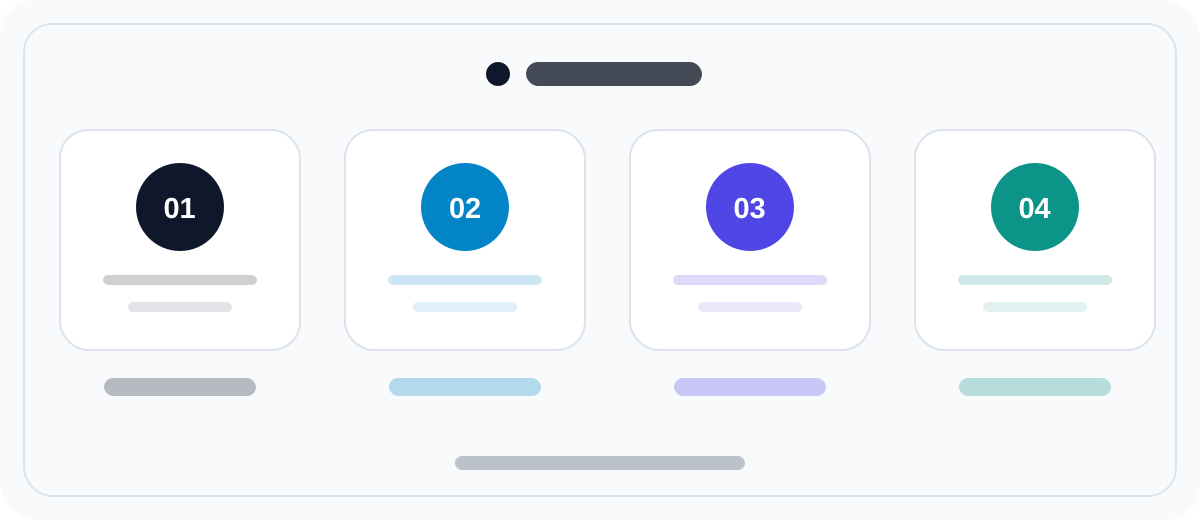
Four things must exist before any channel work is worthwhile.
Identity. A way to recognise the same person across channels — reliably, including when they use a different email or phone number than the one on file. Identity matching is the hardest part and it is a business rule, not an algorithm: deciding whether two records are the same person has real consequences for privacy and billing, and needs an owner.
History. Every interaction, in one timeline, readable by staff in any channel.
Status. The current state of anything in progress — an order, a case, an application — available to every channel from one source of truth.
Handover. What transfers when a conversation moves: the context, the transcript, and whatever the customer already provided.
Without these, adding channels multiplies the number of places a customer can be disappointed.
Choose channels you can actually staff
Every channel carries an expectation. Live chat implies minutes; email implies a day; social implies public visibility. A channel that misses its implied response time damages more than not offering it at all.
Start from where your customers already are rather than from a list of what is possible. Look at how they contact you today, and add a channel only when you can staff it to its expectation during the hours you advertise.
It is entirely defensible to offer three channels well. It is not defensible to offer seven where two go unanswered, and customers judge you on the worst one they tried.
Design the handovers deliberately
The handover is where omnichannel is won or lost, and it raises the same questions every time: what context transfers, what the receiving agent sees before speaking, what the customer has to repeat, and what happens if nobody picks it up.
Self-service to human is the most important one. When someone abandons a form or a chatbot, the agent should receive what was already entered. Making the customer start again after a failed self-service attempt produces more dissatisfaction than not offering self-service.
Give staff one screen
Agents cannot deliver a joined-up experience from four systems. They need one view showing identity, history across channels, current status and the actions they can take.
This is usually the largest piece of work in an omnichannel programme, and it is where the budget should go. An agent assembling context from several tabs is slow, and the customer hears every second of it.
Include the ability to act on behalf of a customer, clearly recorded — support teams need it, and retrofitting it tends to produce something unauditable.
Keep the data lawful
A unified customer view concentrates personal data, which raises the stakes under GDPR and Turkish data protection law. Least-privilege access by role, audit logging of who viewed which record, defined retention per data type, and a lawful basis for combining data collected in different contexts all become necessary rather than optional.
The identity-matching rules deserve particular care: merging two records that turn out to be different people is a data breach, not a data quality issue.
Sequence it in phases
Attempting everything at once is why these programmes stall. A workable order:
One customer record with identity matching and history
Agent view across existing channels
Status visible to the customer in the channels you already have
One new channel, properly staffed
Handovers between self-service and human
Each phase delivers something on its own, which is what keeps the programme funded when priorities shift.
Measure continuity, not channel volume
Track the share of contacts where the customer had to repeat information, resolution rate by starting channel, how often conversations change channel and what happens when they do, and effort scores per journey.
Channel volume tells you where people go. Repeat-information rate tells you whether the omnichannel investment actually delivered the thing it was for.
Frequently asked questions
What should be defined first?
For How to Plan an Omnichannel Customer Experience, start by defining the expected result and owner for customer journey. Then follow one real example through service operations, recording the data used, waiting points, exceptions, and evidence of completion. This creates a more reliable first scope than a screen inventory.
How should success be measured?
For How to Plan an Omnichannel Customer Experience, review journey completion, repeat contact, resolution time, and retention together. Give each measure a definition, data source, owner, review cadence, and response when it crosses a threshold. A single speed or usage metric should not hide quality, rework, or abandonment.
Does this work always require new software?
For How to Plan an Omnichannel Customer Experience, new software is not automatic. If the underlying problem is policy, ownership, training, or an unnecessary approval, fix the process first. Configure an established tool when it supports the critical workflow and data boundary. Consider custom development only when a differentiating rule, integration, or experience creates clear value.
Related guides
Alongside How to Plan an Omnichannel Customer Experience, continue with Customer Portal Development: Workflows, Integrations, and Adoption.
Alongside How to Plan an Omnichannel Customer Experience, continue with Digital Customer Onboarding: Steps, Metrics, and Examples.
If the work prompted by How to Plan an Omnichannel Customer Experience leads to a funded initiative that needs product strategy, design, engineering, or integration support, Discuss Your Customer Platform.
